
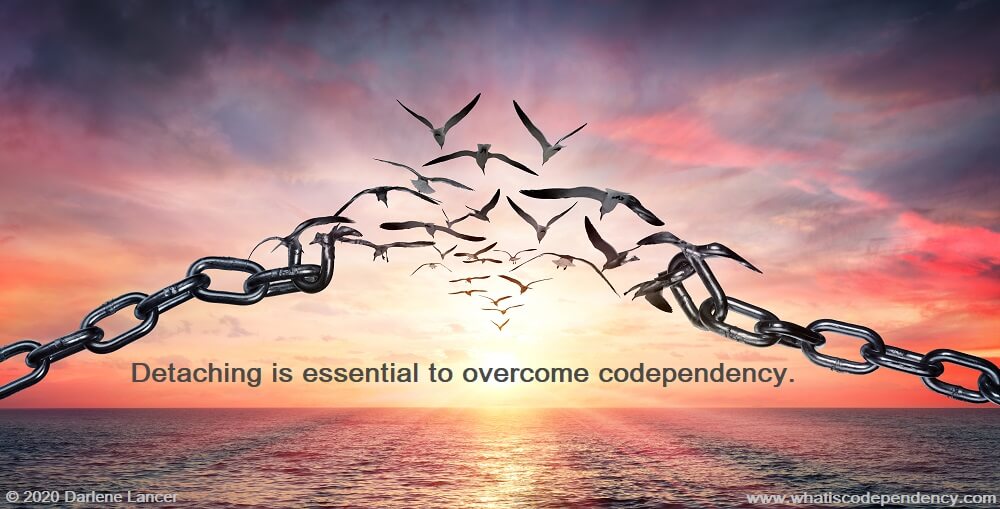
 Letting go can refer to different actions – letting go of anger or resentment, guilt, worry, controlling behavior, or letting go of a relationship. Letting go of someone we love is not easy. Of course, grieving the death of someone is a natural process that takes time. Letting go allows us more freedom in our life and helps us stop controlling behavior. It may feel unloving, but it actually allows us love with compassion instead of manipulation.
Fundamentally, we’re powerless over someone else. Knowing this intellectually and knowing it emotionally are different, but practicing these tips will gradually change your thinking, feeling, and actions. There are many situations where we need to let go, and not all of these tips will apply to yours. Still, they’ve worked for me and countless others:
- Mind your own business & don’t give advice.
- Focus on yourself. Do things that make you happy and further your goals.
- Practice compassion for the other person. Try to see his or her motivation. This doesn’t mean you accept unacceptable behavior, but understanding can help you to not react and to see him or her as separate from you.
- Remind Mantras:
- “Let Go, Let God”
- “Live & Let Live”
- Remember the three C’s:
- You didn’t cause the other person’s problem or addiction.
- You can’t control it.
- You can’t fix it.
- Remember the Four Don’ts:
- Don’t watch
- Don’t expect
- Don’t judge
- Don’t obsess
- Q.T.I.P. Quit Taking It Personally. Other people’s actions don’t reflect on you. Practice listening without reacting.
- Meditation and Mindfulness. This helps you think before you speak and respond instead of react.
- Journal your feelings. Instead of acting on them, write and reflect on them. You can share them with a friend.
- Act as if. Visualize how you’d like to act and respond. Practice doing it even if you feel like strangling the person instead!
- Check in with your body. Are you in your head? Obsession is fed by anxiety in an attempt to control pain or the future. Allow any pent-up feelings to flow. Ask your body what it needs. Are in the present? If action is necessary now, take it; if not, enjoy the present.
- Have a “Plan B.” This is especially important when the other person is unreliable. Instead of feeling like a victim of his or her moods or addiction, make alternate plans, even if it’s to stay at home and finish a novel. Don’t allow your happiness and serenity to be controlled by someone else.
- Practice accepting reality. Are your expectations realistic? Unreasonable expectations feed resentment, disappointment, and futile attempts to control. Expecting an addict not to practice his or her addiction is unreasonable.
- Prayer. Praying for someone you care about, whom you can’t control or change is a positive action. See him or her surrounded in light and send the person blessings.The Serenity Prayer can also be helpful:
“God grant me the Serenity to accept the things I cannot change, “The Courage to change the things I can, “And the Wisdom to know the difference.”
To “Let go” sounds like an action verb, but it’s actually a process. It’s the result of practicing these steps – sometimes painful, but they hold the promise of contentment and renewed vitality. For six more tips, read my blog “Letting Go.”
Copyright Darlene Lancer 2014