

Having up with a highly critical parent can have lasting effects on self-esteem, relationships, decision-making, and emotional well-being. Some parents express criticism openly, others communicate it through gestures, constant correction, perfectionism, or an ongoing emphasis on improving you.
Parents may truly believe they are motivating their children, preparing them for the world, or helping them reach their potential. Parents may care deeply about a child while still communicating in ways that undermine their confidence. Both can coexist. A parent may be capable in other ways, not be a narcissistic or toxic parent, and still cause damage with criticism.
Yet when correction outweighs acceptance, criticism risks making acceptance feel conditional on meeting someone else’s standards. You may come to believe that who you are is never quite enough. The consequences may continue well into adulthood, shaping how you evaluate yourself, respond to mistakes, pursue success, and experience relationships.
The Subtle Signs of a Critical Parent
Criticism does not always involve harshness, belittling, or obvious disapproval. It can be subtle, conveyed in a loving, kind tone or through everyday comments that gradually undermine your confidence and sense of autonomy, such as “Good try; next time… or “Nice, but this is better.”
They might question your choices or comment on your appearance, career, friendships, or lifestyle under the guise of offering helpful advice. Even praise may come with a reminder of what could have been done better. A child receives a good grade, but the parent asks why it wasn’t higher. If you accomplish something meaningful, attention shifts to what needs improvement or remains unfinished.
The repeated use of should or should not can be harmful:
- “You shouldn’t let that bother you.”
- “You should know better by now.”
- “You should be further along in your career.”
- “You should be grateful for what you have.”
- “You shouldn’t be so sensitive.”
The cumulative message is that there is always something to correct. Over time, you may question your judgment and rely on external approval to validate your decisions and actions.
When High Expectations Become Perfectionism
Some parents are perfectionists. They may believe that maintaining high standards is essential to success. Expectations are communicated in ways that make mistakes feel unacceptable or accomplishments seem perpetually insufficient. Rather than learning that effort leads to growth, you may learn that performance determines your worth. Perfectionism can be a strategy to avoid criticism and shame. You overprepare, work excessively, and hold yourself to unrealistic standards in the hope that flawless performance will protect you from disapproval. You may avoid challenges because the possibility of failure feels too threatening.
You may be exceptionally capable but struggle to enjoy your accomplishments. Professional success may be accompanied by feeling inadequate or that you’re a fraud. You set demanding goals without experiencing satisfaction or postpone projects because you cannot meet your own standards. The hidden cost is that achievement becomes less about personal fulfillment and more about proving that you’re good enough.
The Lasting Impact of Internalized Shame
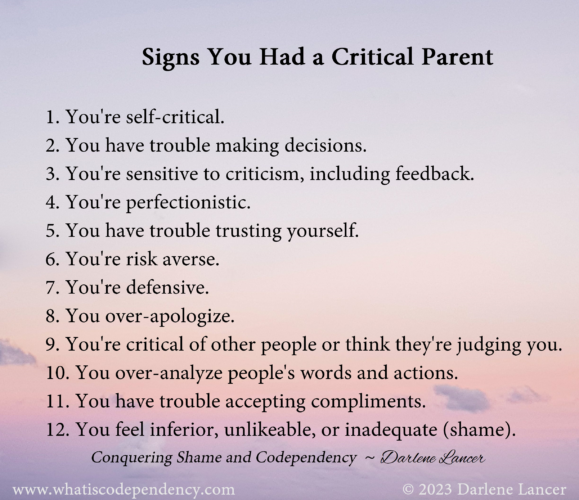
One of the most profound costs of chronic parental criticism is internalized shame: the belief that something is fundamentally wrong with you. No one needs to point out a mistake because you’re already reviewing it, anticipating disapproval, and questioning your own competence. Your internal critic takes over and piles on more shame.
A missed deadline becomes evidence of irresponsibility. An awkward conversation becomes proof of social inadequacy. A disappointing outcome becomes a reason to question one’s overall abilities. Rather than interpreting criticism as information about your behavior, you may experience it as evidence of personal inadequacy.
The message shifts from I made a mistake to I am a failure, or from I could improve to I am not good enough.
Over time, this belief can influence almost every area of life. It may lead you to minimize accomplishments, feel undeserving of love, tolerate poor treatment, struggle to assert your needs, or experience ordinary setbacks as evidence of personal failure. Even success may not provide lasting relief because the underlying sense of inadequacy remains unchanged.
This self-criticism can feel necessary if you believe that being hard on yourself keeps you motivated, responsible, or prepared for challenges. Yet there is a difference between accountability and self-punishment. Accountability helps you recognize mistakes and make changes; shame turns mistakes into judgments about your identity.
Internalized shame can fuel codependency, perfectionism, people-pleasing, anxiety, and harsh self-criticism. It can also affect the ability to trust others, receive affection, and feel comfortable being seen as imperfect. You’re no longer responding only to your parent’s judgments; you’re judging yourself through the same lens.
This is why the effects can be difficult to recognize. Someone may appear confident and successful while privately fearing exposure, rejection, or the discovery that they are not as capable as others believe.
Decision Paralysis and Fear of Mistakes
If your choices were frequently questioned or corrected, you may struggle to trust your own judgment. Choosing a restaurant, responding to an email, purchasing clothing, or considering a career change can trigger excessive analysis and fear of making the wrong choice. The individual may compare every option, seek repeated reassurance, or postpone decisions until certainty feels possible.
This pattern, often described as decision paralysis, can arise when the perceived cost of an imperfect decision becomes greater than the benefit of making progress.
The underlying concern is often not the decision itself but what a mistake might mean: that they are incompetent, irresponsible, or likely to disappoint someone. Learning to tolerate uncertainty and make reasonable decisions without exhaustive reassurance can help rebuild confidence and autonomy.
People-Pleasing and the Fear of Disapproval
With a critical parent, you can learn to monitor others closely and adapt your behavior to avoid negative reactions. This can develop into people-pleasing, as distinguished from kindness, where your behavior reflects a genuine choice, not an underlying fear of rejection. You may find it difficult to say no, express disagreement, or establish boundaries. You may feel responsible for other people’s emotions and interpret disappointment as evidence that you have done something wrong.
In intimate relationships, you may be highly sensitive to perceived criticism and interpret it as rejection. You may try to prove your value by doing more than your share or gravitate toward relationships in which approval is difficult to earn because the dynamic feels familiar.
The Emotional Cost of Never Feeling Good Enough
Chronic criticism and internalized shame contribute to anxiety, self-doubt, imposter syndrome, and heightened sensitivity to disapproval. A change in someone’s tone, a delayed text message, or constructive feedback at work may trigger disproportionate worry.
Another consequence is difficulty accepting praise. Someone who has learned to focus on shortcomings may dismiss compliments, minimize achievements, or immediately explain what went wrong. Positive feedback feels uncomfortable because it conflicts with the belief that something is always lacking.
Constantly trying to prove your worth can make rest feel undeserved, success temporary, and satisfaction elusive because there is always another milestone to reach.
Breaking the Pattern
The effects of a critical upbringing are not inevitable or irreversible. Recognizing learned patterns can help you develop a more balanced relationship with yourself.
- Recognize the internal critic. Notice when self-evaluation becomes personal condemnation. Use the exercises in How to Raise Your Self-Esteem to turn a critic into a coach.
- Examine the source. Ask yourself: Were mistakes treated as opportunities to learn or as evidence of inadequacy? Could feelings be expressed without ridicule? Was there room to disagree, make decisions, and develop an independent identity?
- Question inherited expectations. When thoughts are judgmental, consider whether they reflect personal values or learned values or standards and fear of disapproval. This allows you to develop your own standards, trust your judgment, and build relationships in which acceptance does not have to be continually earned.
- Overcome perfectionism. Make reasonable decisions without exhaustive reassurance. Allow mistakes to become opportunities to learn rather than verdicts on personal worth. Take the steps in How to Beat Perfectionism.
- Develop boundaries. Other people’s disappointment does not automatically mean you have done something wrong. Give yourself permission, and learn How to Be Assertive.
- Seek support when needed. Therapy can help address entrenched shame, perfectionism, anxiety, and relationship patterns, particularly when they interfere with daily functioning.
- Heal the shame. To go deeper and heal the underlying shame, do the exercises in Conquering Shame and Codependency.
The goal is not to eliminate ambition, reject all criticism, or assign blame for every adult difficulty. It is to distinguish constructive feedback from the belief that one’s worth is perpetually in question.
You Are More Than What Needs Improving
Growing up with a highly critical parent can teach you to be hypervigilant and be constantly aware of and try to hide and correct perceived inadequacies. Achievement becomes a way to establish worth, perfectionism a means of avoiding disapproval, and self-criticism an attempt to prevent future mistakes.
But lasting self-worth cannot depend entirely on meeting ever-changing standards. You can be responsible without being relentlessly self-critical, ambitious without being perfectionistic, and receptive to feedback without treating it as a judgment of your value.
The essential shift is from believing you must become good enough to deserve acceptance to believing that you already are.
© 2026 Darlene Lancer